
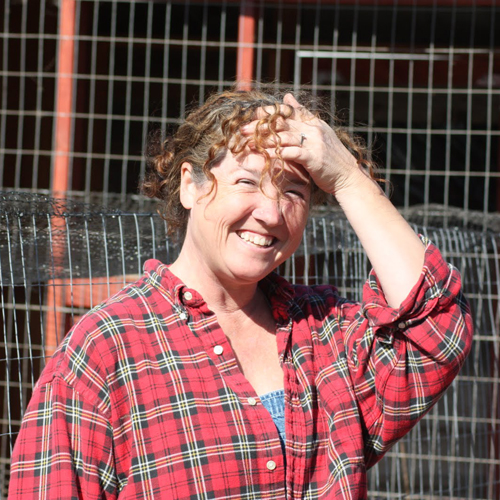
LIsa Black
Cape Coral, FL
Female, 49


I spent the five happiest years of my life in a morgue. As a forensic scientist in the Cleveland coroner’s office I analyzed gunshot residue on hands and clothing, hairs, fibers, paint, glass, DNA, blood and many other forms of trace evidence, as well as crime scenes. Now I'm a certified latent print examiner and CSI for a police department in Florida. I also write a series of forensic suspense novels, turning the day job into fiction. My books have been translated into six languages.
It all depends on where you want to work and what they require. At the coroner's office we all had at least a bachelor's degree in a natural science like biology, because there were not any forensic degrees then. If you want to be a DNA analyst you will probably need to major in genetics or biochemistry. At the police department where I work, with our very small lab, we are only required to have a high school diploma--but you get extra points in the interview process for advanced degrees so we all have at least a bachelor's.Hope that helps.
Share Answer: 

If you look through previous answers you'll find a number pertaining to this. Each agency and position may have different requirements so the only way to know is to call the places you are interested in working at and ask them. For my current job I only need a high school diploma but we all have at least a Bachelor's degree. If you want to do DNA analysis they may require a PhD. I applied to the police department that posted the vacancy. Most have online postings now so it's pretty easy. Yes, I've had a lot of continuing education through other police departments and forensic organizations.
Share Answer: 
If bones survive the cremation process and show signs of physical trauma (such as fractures), then yes.
Share Answer: 
I would think that would become obvious at the autopsy. If the victim is not dead, say missing, then that information would most likely come to light when they talk to the victim's doctor or family members.
Share Answer: 
Help Desk Technician
 Do the stats actually back up the "Mac's never get viruses and crash way less than PCs" thing?
Farmer
 Do friends with office jobs look down on what you do?
Bartender
 How often would you date customers?
There are numerous techniques for obtaining fingerprints from surfaces--black powders, colored powders, alternate light, superglue, dye staining. Once you can visualize the print, comparing one to another is done by noting all the information (where ridges end, divide, form a dot, have a scar, etc.) in one pattern and comparing it to another print's pattern. This can be done by a computer so that thousands to millions of prints can be searched quickly, all day, every day, all over the world, but is always confirmed by human beings. Despite what you see on TV!
Share Answer: 
Who knows? It all depends on where the samples were and how thoroughly the surface was cleaned. If blood was on a glass window and it was thoroughly cleaned, then all of it is probably gone for good. If it's a porous bare wood, then probably not...unless it was thoroughly soaked with a bleach solution. If it's a large area, even if it's cleaned there might still be some left in the nooks and crannies--like in a tile floor, the ceramic may be clean but the more porous grout between the tiles might hold a substance. So there is no way to say it's always possible or it's always not possible. PS Luminol helps you find blood. Christmas Tree stain is used to stain a dried semen sample on a glass slide. It doesn't help you find the semen in the first place.
Share Answer: 
It depends entirely on where you work. The requirements are whatever your employer says they are (same with your job title). DNA analysts are often required to have a PhD in genetics. At the coroner's I had to have a BS in one of the natural sciences. At my police department they only require a high school diploma, but give extra points for advanced schooling so we all have BSs. The best way to get an idea is to go to different agencies' websites and look at help wanted postings.
Share Answer: 
-OR-
 Login with Facebook
 (max 20 characters - letters, numbers, and underscores only. Note that your username is private, and you have the option to choose an alias when asking questions or hosting a Q&A.)
(A valid e-mail address is required. Your e-mail will not be shared with anyone.)
(min 5 characters)
By checking this box, you acknowledge that you have read and agree to Jobstr.com’s Terms and Privacy Policy.
-OR-
Register with Facebook(Don't worry: you'll be able to choose an alias when asking questions or hosting a Q&A.)



 Browse Jobs
 Host a Q&A
 Search

 Submit Your Question
 Host a Q&A
 Last 7

